Friday, April 20, 2012

BMG Team Completes Management Training

BMG Rentals Property Management Team Completes Intensive Management Training

Members from the Salt Lake and Idaho Falls locations completed over 40 hours of training while in Boise attending the National Association of Residential Property Managers (NARPM) Northwest Regional Conference. The coursework included Owner/Client Relations, Ethics, and Maintenance: Basics and Beyond. "Continuing education within the management area I specialize in is critical to my ability to stay current on the issues affecting the property management industry," says Wyatt Wetsel, Maintenance Coordinator at the Idaho Falls office.


The professional course work provided through NARPM is taught many times during the year in various metropolitan areas. Members often travel from across the country to attend these NARPM classes. They are unique to the real estate industry as the specifically address the needs of the single family residential property manager. 


There are currently over 3500 members of NARPM, the nation's only professional organization for managers of residential properties, from single family unit to 4-plexes. Members represent over $20 billion in residential rental properties nationwide.


The instructors of these courses are veterans in the property management industry. See their information below:

Suzanne CameronSuzanne Cameron, MPM® RMP®

Suzanne Cameron, MPM® RMP®, began her real estate career in 1978, specializing in residential property management in 1981. She has been the president and broker of Around The Clock, Inc., CRMC®, in Kent, Washington since 1990. Her company added a condo and homeowners association department in 1992 and a sales department the following year. She manages and supervises fifteen personnel. She has been an active member of NARPM® since 1994. She started the King County Chapter the same year and helped to start five other chapters in her region while serving as a Regional Membership Coordinator form 1995 to 1997. She was a NARPM® National Director from 1995 to 1998 chairing the Legislative and Publications Committees and was chair of the last Midyear Conference in 2002. She has also served on the Membership, Convention, and Certification Committees.


Tony Drost, MPM® RMP®


Tony DrostTony started First Rate Property Management, Inc. (FRPM) in 1995. FRPM currently manages over 800 units and employs 13 people. He has a BA Degree in Operations Management, which gave him the tools to be an effective manager. However, Tony credits his involvement with NARPM® for the real financial success and streamlining of his company. Over the years, Tony has applied what he has learned from NARPM® and its members, and has delegated the day-to-day operations to staff members. He focuses on strategic planning for the company and is constantly seeking out new ways to become more efficient. Tony learns something new at every NARPM® event and looks forward to networking with you.


     

Tuesday, April 10, 2012

10 Spring Maintenance Tips


10 home maintenance tips for spring


<a href="http://www.shutterstock.com/gallery-786385p1.html" target=blank>Man cleaning gutter image</a> via Shutterstock.Man cleaning gutter image via Shutterstock.
The sun is peeking out and the plants are starting to blossom, so it must be about time for spring chores again. Here's my annual spring checklist of important issues to tend to around the house.
1. Roofing repairs: If you suspect winter storms may have damaged your roof, it needs to be inspected. (If you're not comfortable with the height or steepness of your roof, hire a licensed roofing contractor for the inspection.) Look for missing or loose shingles, including ridge-cap shingles.
Examine the condition of the flashings around chimneys, flue pipes, vent caps, and anyplace where the roof and walls intersect. Look for overhanging trees that could damage the roof in a wind storm, as well as buildups of leaves and other debris.
If you have roof damage in a number of areas, or if older shingles makes patching impractical, consider having the entire roof redone. Also, remember that if the shingles have been damaged by wind or by impact from falling tree limbs, the damage may be covered by your homeowners insurance.
2. Check gutters and downspouts: Look for areas where the fasteners may have pulled loose, and for any sags in the gutter run. Also, check for water stains that may indicate joints that have worked loose and are leaking. Clean leaves and debris to be ready for spring and summer rains.
3. Fences and gates: Fence posts are especially susceptible to groundwater saturation, and will loosen up and tilt if the soil around them gets soaked too deeply. Check fence posts in various areas by wiggling them to see how solidly embedded they are.
If any are loose, wait until the surrounding soil has dried out, then excavate around the bottom of the posts and pour additional concrete to stabilize them. Replace any posts that have rotted.
4. Clear yard debris: Inspect landscaping for damage, especially trees. If you see any cracked, leaning or otherwise dangerous conditions with any of your trees, have a licensed, insured tree company inspect and trim or remove them as needed.
Clean up leaves, needles, small limbs and other material that has accumulated. Do any spring pruning that's necessary. Remove and dispose of all dead plant material so it won't become a fire hazard as it dries.
5. Fans and air conditioners: Clean and check the operation of cooling fans, air conditioners and whole-house fans. Shut the power to the fan, remove the cover and wash with mild soapy water, then clean out dust from inside the fan with a shop vacuum -- do not operate the fan with the cover removed.
Check outdoor central air conditioning units for damage or debris buildup, and clean or replace any filters. Check the roof or wall caps where the fan ducts terminate to make sure they are undamaged and well sealed. Check dampers for smooth operation.
6. Check and adjust sprinklers: Run each set of in-ground sprinklers through a cycle, and watch how and where the water is hitting. Adjust or replace any sprinklers that are hitting your siding, washing out loose soil areas, spraying over foundation vents, or in any other way wetting areas on and around your house that shouldn't be getting wet.
7. Check vent blocks and faucet covers: As soon as you're comfortable that the danger of winter freezing is over, remove foundation vent blocks or open vent covers to allow air circulation in the crawl space.
While removing the vent covers, check the grade level around the foundation vents. Winter weather can move soil and create buildups or grade problems that will allow groundwater to drain through the vents into the crawl space, so regrade as necessary. Remove outdoor faucet covers. Turn on the water supply to outdoor faucets if it's been shut off.
8. Prepare yard tools: Replace broken or damaged handles, and clean and condition metal parts. Tighten fittings and fasteners, sharpen cutting tools and mower blades, and service engines and belts in lawn mowers and other power equipment.
9. Change furnace filters: Now is the time to replace furnace filters that have become choked with dust from the winter heating season. This is especially important if you have central air conditioning, or if you utilize your heating system's fan to circulate air during the summer.
10. Check smoke detectors: Daylight Savings Time snuck up early again this year, and that's usually the semi-annual reminder to check your smoke alarms. So if you haven't already done it, now's the time. Replace the batteries, clean the covers, and test the detector's operation before it's too late.
If you have gas-fired appliances in the house, add a carbon monoxide detector as well (or check the operation of your existing one). CO2 detectors are inexpensive and easy to install, and are available at most home centers and other retailers of electrical parts and supplies.
Posted by:  BY PAUL BIANCHINA, FRIDAY, APRIL 6, 2012.

Thursday, April 5, 2012

Protect Yourself From Craigslist Rental Scams


As featured recently on the Channel 8 and Channel 3 news in Idaho Falls, we are seeing an increase in the number of Craigslist scams on rental properties. Check out the news story here then read below on how to avoid being a victim.


Top 5 ways to tell if the add is a scam:

1. The person listing the property and asking for money is not local
2. They can't get you in to see the property
3. They want you to send money out of the country
4. They are unable to provide you with a receipt or lease agreement at time of payment
5. If the rent price sounds too good to be true it probably is . . .

Consumers should ask a lot of questions and tour the property before sending anyone money. They should also get a lease agreement and deposit receipt when paying. These types of scams are easy to avoid if you have the right information. Contact a professional property manager and they can help you determine if you are being scammed.


Friday, March 30, 2012

Importance of Rental Payment History

Most people think credit and criminal are all that matters . . . The experts at Experian have a little more to say.

Used in conjunction with credit evaluations and traditional screening methods, rental payment history can go a long way toward filling up an apartment community with qualified renters who pay on time.

Resident screening companies love data. To determine whether or not a prospect is worthy of renting an apartment, vast databases are scanned for past purchasing behaviors, job histories, on-time and overdue payments and of course, credit history. Landlords and leasing agents have known it for years: a social security number is the best information an apartment prospect can provide on an application. Check personal references? Maybe. Check credit? Absolutely.

But credit scoring isn’t necessarily the Holy Grail it used to be when determining a resident’s propensity to pay rent on time. Consider the millions of Americans who lost a home due to a foreclosure, or someone who temporarily lost a job in the recession and was unexpectedly hit with medical bills and no health insurance. Particularly in our current economic climate, there are lots of reasons why a rental applicant might have poor credit, limited credit or no credit at all. Furthermore, some of these criteria might have little (if any) impact on whether or not they will pay their rent.

Since apartment operators depend on rents for success and survival, knowing each individual resident is going to pay up on the first of the month is critical to establishing net operating income (NOI) and consistent revenue. From there apartment owners can accurately determine the market value of their real estate, decide when and where to invest in capital improvements and make informed decisions on buying and selling property: all based on rent roll.

With recent swings in the homeownership ratio, more than 1/3 of the U.S. population rents, and what better way to determine creditworthiness of rental applicants than to consider how they have historically paid their rent. Experian RentBureau began incorporating residential rental payment data into credit reports over a year ago, and according to our research, inclusion of positive rental payment history data will pull one in three consumers out of high-risk categories and put them in better qualifying scoring bands.

The easiest way to help residents establish credit is to furnish their payment data. Offering prospects and residents such an easy way to establish and rebuild their credit score—simply by paying their rent on time—is likewise a huge benefit apartment communities can easily market as a turnkey amenity. This is a message surely any rental prospect would love to hear from a leasing agent.

In addition to the resident credit-building benefits of furnishing rental payment history, accessing trend data on payment history has recently emerged as a primary metric employed in screening practices to employ as another layer separating the good renters from the bad. Used in conjunction with credit evaluations and traditional screening methods, rental payment history can go a long way toward filling an apartment community with the highest-quality renters who pay on time. Building a resident demographic of credit-worthy renters thus has an immediate positive effect on NOI, reducing the overall likelihood of skips and decreasing exposure to bad debt and its associated collections costs.

The M.O. is relatively simple: in addition to raw credit, rental payment history looks at how well an applicant has historically paid their rent. A lower credit score matched with a rental history that shows on-time, every time rent payments suddenly becomes a qualified rental candidate—and one who other property managers not utilizing rental payment history might decline.

“Rental payment history has helped us to identify applicants who are more than likely to honor their rental obligations based on their past history of paying their rent timely,” says Michael Johnson, executive vice president and chief administrative officer of ALCO Management. “By using rental payment history as part of your screening criteria, you can make a faster, more consistent decision regarding the application.”

Brannan Johnston is vice president and managing director of Experian RentBureau, the largest and most widely used credit bureau in the multifamily industry. In addition, he oversees the income and asset suite of products within Experian’s Consumer Information Services.


Thursday, March 22, 2012

Refinance now? New HARP Guidelines Released


The government's new HARP 2.0 Refinance Program is available to U.S. homeowners as of March 17, 2012. 

What Is HARP?

HARP was started in April 2009. It goes by several names. The government calls it HARP, as in Home Affordable Refinance Program. The program is also known as the Making Home Affordable plan, the Obama Refi plan, DU Refi +, and Relief Refinance.
In order to be eligible for the HARP refinance program :
  1. Your loan must be backed by Fannie Mae or Freddie Mac.
  2. Your current mortgage must have a securitization date prior to June 1, 2009
If you meet these two criteria, you may be HARP-eligible. If your mortgage is FHA, USDA or a jumbo mortgage, you are not HARP-eligible.


Basics of the new guidelines:


  • No  limit to loan to value
  • All properties owned by Fannie Mae or Freddie Mac are eligible as long as they are still used for what they were originally financed as (a primary residence converted to an investment property doesn’t qualify)
  • An investor that has recently lost a property to foreclosure or short sale and wants to refinance his others will be able to
  • Maximum cash back is $250
  • Closing costs may be financed into the new loan
  • Full documentation is still required (verifying income and assets)
  • Current loan must have been originated prior to May 31, 2009
  • Minor rate adjustment

Contact your mortgage broker or banker for more information.

Tuesday, March 20, 2012

Simple Fixes for Common Appliance Problems


Simple Fixes for Common Appliance Problems | from The Family Handyman


Simple Fixes for Common Appliance Problems
At least a quarter of all appliance repair calls are resolved with no-brainer solutions like pushing a button or flipping a circuit breaker. Learn what to look for and how to avoid these expensive lessons.


    Disposer


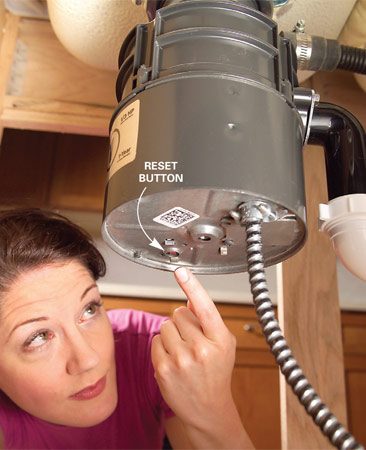
    All disposers have an overload feature that automatically shuts off the power when the motor becomes overloaded and gets too hot. Once the motor cools, simply push the reset button on the side of or under the unit.
    On the other hand, if it hums but doesn't spin, it may have something stuck in it. Switch the disposer off, then try working through it by turning the blades with a special disposer wrench (sold at home centers) or by turning a bottom bolt. Many disposers have an Allen wrench for that purpose, inset on the bottom of the machine.

    Lights

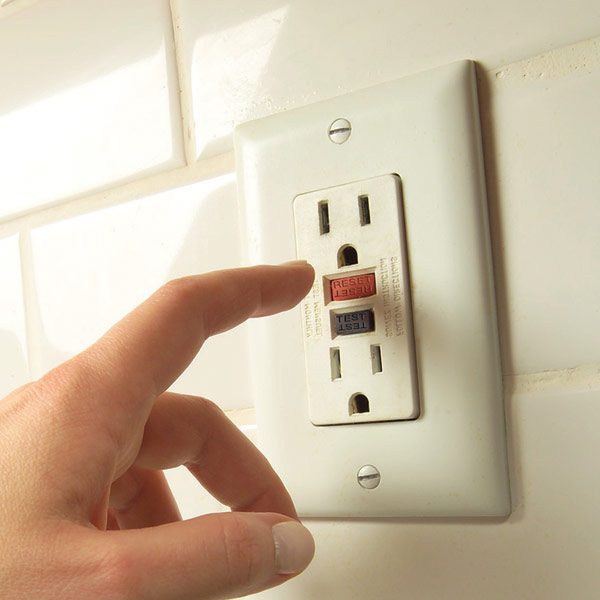
    When a light goes out or a switch doesn't work, you should first check the main electrical panel for a tripped circuit breaker. But don't stop there. Before you change out light bulbs and switches, see if a GFCI outlet (which may be upstream from the troubled light or outlet) has tripped. Sometimes all the bathrooms or the outside lights are powered through a single GFCI located in one bathroom or elsewhere, such as in a basement. Simply push the reset button on the GFCI and you could be back in business.

    Refrigerator


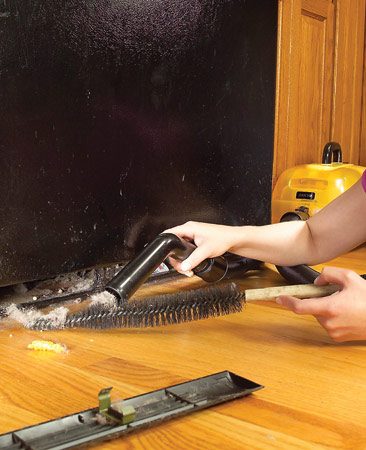
    If your refrigerator conks out on a hot day and you have a cat or a dog, immediately check the coils for pet hair. Service pros find this problem on half of their refrigerator calls. The coils are the black tube-and-wire grid that cools the fluid in the compressor. A buildup of hair will cause the compressor to overheat and trigger the overload switch. On many fridges, you get to the coils by opening the grille at the bottom of the refrigerator. Then push a coil cleaning brush (sold at home centers) into the coils, pull it back and vacuum it clean.
    If the coils are located on the back, pull out your fridge (it's often on rollers) and brush them off. Bonus: The clean coils will cool more efficiently and save you money on your utility bill!
    Once the overload switch is tripped, you may have to wait a few hours for it to cool. It will reset itself and turn the refrigerator back on.

    Gas stove


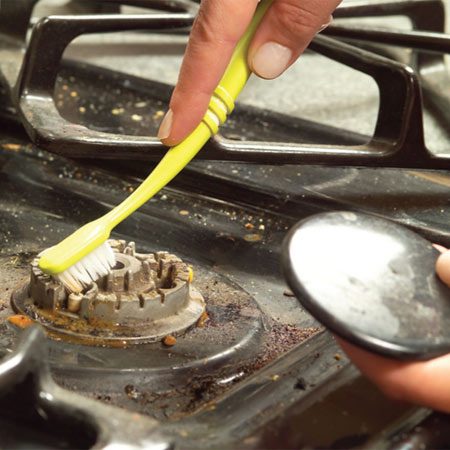
    If your stove burner won't come on, the likely culprit is the spaghetti sauce that boiled over a few days ago. Use a toothbrush to clean off food spills from the igniter. On an electronic ignition stove, it's a little ceramic nub located either on the stovetop or under the ceramic seal strike plate. Also make sure that the round ceramic seal strike plate is properly seated on the burner.

    Electric range

    If your electric stove burner won't heat, turn the burner off and pull it out from its socket. Then plug it in again and wiggle it around. If it feels loose, remove the burner again and gently bend the burner prongs slightly outward for a tighter connection. Easy does it. You could end up pushing the whole socket out of its bracket.

    Standing pilot gas range

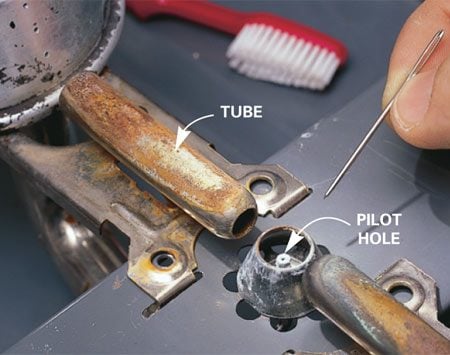
    To access the ignition system in an older-style standard gas range, pop the lid. It's usually hinged on the back side. If the pilot flame is out, poke a needle into the pilot hole to clean out soot (be careful not to ream it wider). Brush off any debris and clean the tube that leads from the pilot to the burner. Then relight the pilot.

    Electronic oven controls

    Blame it on the technology. It so happens that if you set the “time cook” function, the oven, much like a programmed VCR, won't turn on until the appointed time. You may have done this inadvertently, but if your digital display reads “hold,” “delay” or “time cook,” then the timer is engaged. You'll have to clear it first by pushing the “off” button. On ovens with dials, be sure the knob is turned to “manual.”

    Washer


    When a washing machine cabinet rocks, it makes a horrible racket during the spin cycle. The solution is to simply readjust the legs. Screw the front legs up or down until the cabinet is level. When both legs are solid on the floor, tighten each leg's locking nut. In most washers, to adjust the rear legs, gently tilt the machine forward and gently lower it down. The movement will self-adjust the rear legs.

    Dryer


    Our expert repairman responds to many “dryer-not- heating calls” only to find that the machine is set to “fluff air”—a non-heat setting. Avoid the embarrassment. Check the settings first.
    Another common cause of poor drying is a clogged lint filter. The filter may look clean, but it may actually be covered by a nearly invisible film caused by dryer sheets. This film reduces airflow and forces the thermostat to shut off the heat before your clothes are dry. Test your filter by pouring water into it. If the filter holds water, it's past time to clean it. Pull out the filter and scrub it in hot water with a little laundry detergent and a stiff kitchen brush.
    Also check the outside dryer vent for any lint that may have built up there. The louver door–style vent covers are notorious for lint buildup, which traps heat and turns the heat off in the dryer. Pull the cover completely off to get to these clogs.

    Air conditioner


    If you turn your central air conditioner on, off and then on again in rapid order, chances are you'll blow a fuse or shut off a circuit breaker or the air conditioner simply won't respond. That's because the compressor (in the outdoor condensing unit) may have stopped in a high compression mode, making it difficult to start until the compression releases. Older condensing units may switch the compressor on anyway, which causes the circuit to overload and blow a fuse. Newer, “smarter” condensing units will prevent this blunder by delaying the AC’s “on” function for a few minutes. It's easy to mistake this delay with a faulty air conditioner. Be patient and give the air conditioner about five minutes to come back on.
    To determine if you have a blown fuse, locate the special fuse block near the outside unit. Pull out the block and take the whole thing to the hardware store. A salesperson can test the cartridge fuses and tell you if you need to replace them.
    Another simple reason your AC might not come on: You've signed up for a cost discount with your electric company in exchange for limited air conditioning during high-demand periods, and you're in an “off” period. If you can't remember, call your electric company to find out. You don't want to pay the repair technician to drive out and explain this program to you!

    Dishwasher

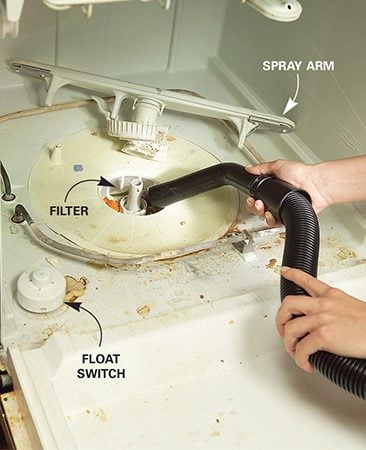
    When your dishwasher no longer gets your dishes clean, a food-filled filter is most often to blame. If it's clogged, water can't make it to the spray arms to clean the dishes in the top rack. The fix takes two minutes. Simply pull out the lower rack and remove the filter cover inside the dishwasher. (Check your owner's manual if you can't spot the filter.) Then use a wet vacuum to clean off the screen.
    While you're there, slide the nearby float switch up and down. If it's jammed with mac and cheese, you won't get any water. If the cover sticks, jiggle it up and down and clean it with water